Reid Vapor Pressure Testing in Southeast New Mexico: Why It Matters and What We Now Offer
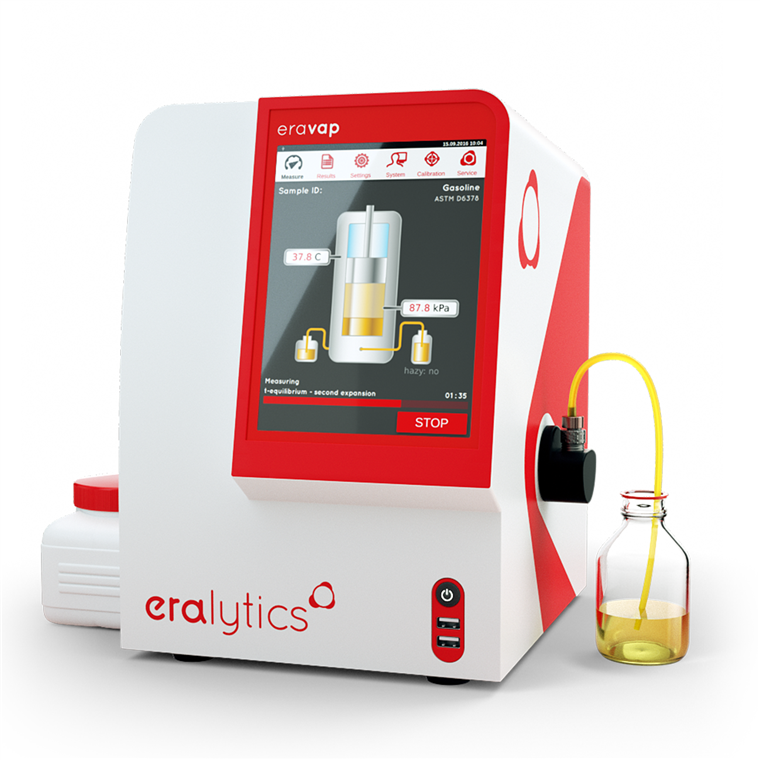
SampleTech Labs has added Reid vapor pressure (RVP) and related vapor pressure testing to its oilfield analytical services. The measurements are performed on an Eralytics ERAVAP analyzer, an automated instrument designed for crude oil, condensate, gasoline, and other volatile liquids. This article explains why vapor pressure data have become operationally and regulatorily significant for producers in southeast New Mexico, and how the new capability supports those needs.
What vapor pressure measures
Vapor pressure describes the tendency of a liquid to release vapor at a given temperature. For crude oil and condensate, the measurement serves as an indicator of the light hydrocarbon fraction that remains dissolved in the liquid. A stabilized crude with a low vapor pressure retains little of this fraction, whereas a poorly stabilized crude or condensate retains substantial amounts that can flash when the liquid is exposed to lower pressure or higher temperature. The traditional Reid method reports this property at 100 °F, and crude oil pipeline tariffs in the Permian Basin commonly define RVP in this way.[3]
Why southeast New Mexico is a distinct case
Eddy and Lea counties sit in the northern Delaware Basin portion of the Permian Basin, one of the most productive oil provinces in North America. Three factors make vapor pressure data particularly relevant in this region.
1. State air quality regulation
New Mexico adopted 20.2.50 NMAC, the Oil and Gas Sector Ozone Precursor Pollutants rule, which took effect on August 5, 2022.[1] The rule sets emission standards for volatile organic compounds (VOCs) and oxides of nitrogen from oil and gas production, processing, compression, and transmission sources.[1] Eddy and Lea counties are among the counties in which sources are subject to the rule, and storage tanks are among the equipment categories it addresses.[2] The New Mexico Environment Department has also noted that Permian Basin oil and gas emissions contribute to elevated ozone concentrations in Lea and Eddy counties.[4]
Storage tank VOC emissions depend heavily on how much volatile material the stored liquid contains. Flash emissions occur when produced liquid is exposed to a temperature increase or pressure decrease as it moves from a separator into an atmospheric tank.[5] Measured vapor pressure gives operators an empirical, laboratory-based indicator of the liquid’s volatility, and it supports the engineering judgment applied to tank emission estimates, control device sizing, and the demonstration of good operating practice.
2. Pipeline and purchaser quality specifications
Crude oil leaving a lease in the Permian Basin typically enters a gathering or trunk line subject to a carrier tariff. Carrier tariffs in the region, including those of systems that originate in Lea County, define Reid vapor pressure and set quality requirements for accepted crude.[3] Industry analysts attribute pipeline vapor pressure specifications to two principal drivers: limits on emissions from midstream storage tanks, and the reluctance of refiners to pay crude oil prices for natural gas liquids contained in the stream.[6] Published tariffs and crude quality bulletins illustrate the range of limits in use. Some specify maximum values near 9 psi, and others, such as the BP1 system, use 11.0 psi.[7][8] A shipper whose crude exceeds the applicable limit can face rejection, penalties, or a requirement to stabilize or blend. Accurate vapor pressure data therefore protect both the value of the barrel and the ability to move it.
3. Hazardous materials classification and transportation
Federal regulation at 49 CFR §173.41 requires offerors of unrefined petroleum-based products, including crude oil, to maintain a sampling and testing program that supports correct classification of the material for transportation.[9] The Pipeline and Hazardous Materials Safety Administration withdrew a 2017 proposal to set vapor pressure limits for crude oil transportation in 2020, concluding after a Sandia National Laboratories study that vapor pressure was not a significant factor in the severity of fire scenarios.[10] The federal rules therefore do not impose a transportation vapor pressure limit. Nonetheless, vapor pressure remains one of the physical properties that shippers examine when characterizing a crude stream, and some states, such as North Dakota, have adopted their own standards.[10]
The measurement system we use
The ERAVAP analyzer draws a small sample into a sealed, temperature-controlled measuring cell. A piston with an integrated pressure sensor records the vapor pressure after the cell reaches the specified test temperature. Peltier heating and cooling allow operation from −20 °C to 120 °C (4 °F to 248 °F), and the manufacturer reports repeatability of r ≤ 0.15 kPa for pure substances.[11] The platform includes a built-in shaker for crude oil measurements and supports variable vapor-to-liquid ratios, and the manufacturer states that it complies with crude oil methods including ASTM D6377.[11][12]
The platform is designed to support the following standard methods.[11][12]
| Method | Application |
|---|---|
| ASTM D6377 | Vapor pressure of crude oil (VPCRx) |
| ASTM D5191 | Total vapor pressure of gasoline and gasoline-oxygenate blends |
| ASTM D6378 | Absolute vapor pressure, triple expansion method |
| ASTM D5188 | Vapor-liquid ratio temperature |
| ASTM D6897 | Vapor pressure of liquefied petroleum gas |
Results from the instrument also correlate with the traditional Reid method (ASTM D323), which allows new measurements to be compared with historical RVP records.[11]
Sampling considerations
Vapor pressure is among the properties most sensitive to sample handling. Light hydrocarbons are lost first when a container is underfilled, warmed, or opened repeatedly, and the resulting value will understate the true volatility of the liquid. Operators should collect representative samples in appropriate containers, minimize headspace, keep samples cool, and deliver them promptly. SampleTech Labs accepts samples at its Carlsbad laboratory and at drop-off locations in Orla and Odessa, Texas, and Williston, North Dakota.
Add vapor pressure to your testing program
Contact SampleTech Labs to discuss RVP testing, sample containers, and reporting. Contact us or call (432) 755-0010.
- 20.2.50 NMAC, Oil and Gas Sector – Ozone Precursor Pollutants (New Mexico State Records Administrator)
- NMED, Ozone Precursor Rule Part 50 training materials, January 2023
- Enterprise Interstate Crude LLC tariff (definition of Reid vapor pressure at 100 °F)
- NMED Air Quality Bureau, 2022 Path Forward (EPA)
- TCEQ RG-622, Calculating VOC Flash Emissions from Crude Oil and Condensate Tanks
- RBN Energy, Prepping Crude Pipelines and the Mini-Crisis in the Permian
- Texas Railroad Commission filed crude oil tariff (maximum Reid vapor pressure 9.0 psi)
- BP1 crude list (11.0 psi Reid vapor pressure maximum)
- 49 CFR §173.41, Sampling and testing program for unrefined petroleum-based products
- PHMSA, Vapor Pressure of Unrefined Petroleum Products and Class 3 Materials; withdrawal, Federal Register, May 20, 2020
- Eralytics, ERAVAP product brochure
- Eralytics, ERAVAP catalog excerpts